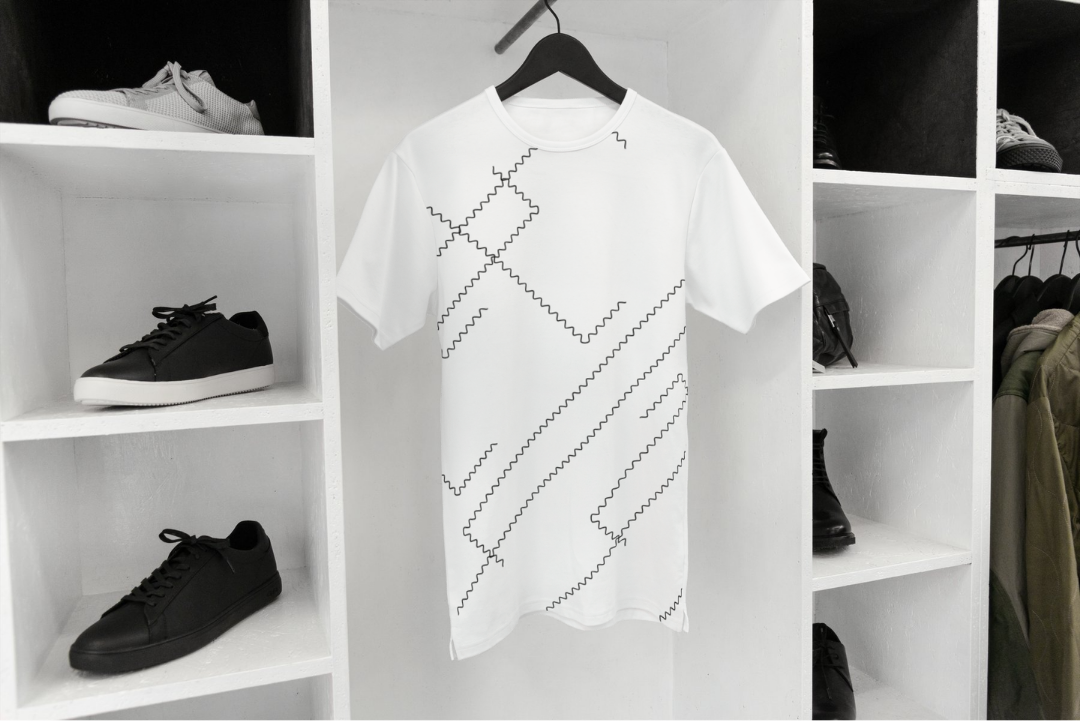
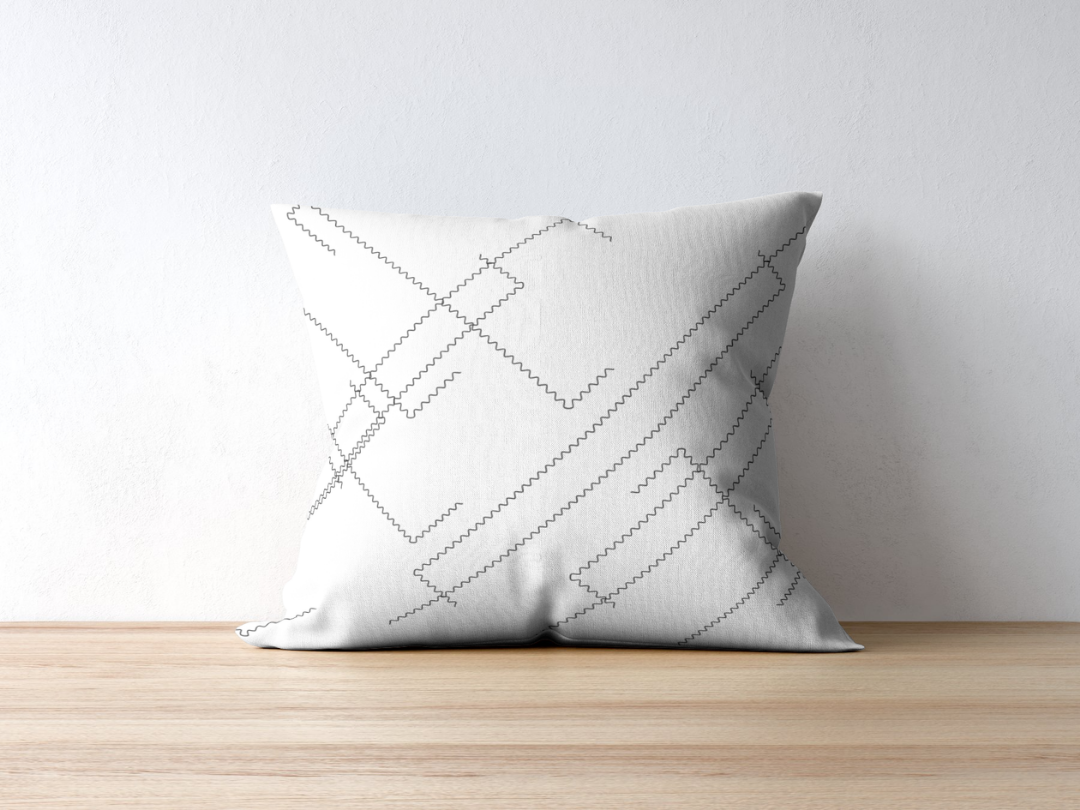
A walker that never leaves its tile becomes
a curve with its own landscape.
I am an Iranian-born artist working at the intersection of
line-drawing traditions and generative systems. My work
begins with a simple observation: the drawn line —
continuous, intentional, infinitely variable — has always
been a form of computation, long before computers.
Wandering Tiles renders a 4–5 × 4–5 grid
of tiles, each containing a single wandering curve. Inside
each tile, a walker takes a fixed number of steps. At every
step, its direction is updated by a simple parity rule:
if the walker's grid position has even parity, it turns one
way; if odd, it turns the other. A containment check flips
the walker 180° if it approaches the tile's margin.
The result is a meandering line that fills each tile
without ever crossing its boundary. Each tile has its own
starting direction, its own step size, and its own
meandering path. The result sits between sketch and
textile repeat. Each piece is defined by a numeric seed
and can be regenerated, documented, and adapted for print,
textile, and surface applications.
On AI tools — where I encountered technical
obstacles, I turned to AI tools for debugging and code
optimization. Every structural, aesthetic, and conceptual
decision remained my own.