Variation
A numeric seed initializes the background tone, the circle count (100–500), the twist range (π to 5π), and every circle's angle, radius, colour, and stroke weight. Each output is regenerated and documented as a distinct, traceable work.
A field of glowing rings — each positioned along a twist, each tinted from the spectrum, drifting out of a pastel field.
For fashion houses, textile studios and surface designers. Each composition is generated from a numeric seed and can be licensed, adapted or commissioned to your brief.
A circle drawn from a distance becomes a vibration — and every vibration leaves a trace.
I am an Iranian-born artist working at the intersection of classical textile logic and generative systems. My work begins with a simple observation: the woven surface — repetitive, mathematically structured, infinitely variable — has always been a form of computation, long before computers.
Twist 1 is a study in accumulation. One hundred to five hundred glowing rings are positioned along a mathematical twist — each at its own angle, each with its own radius, each tinted from the RGB spectrum. The rings overlap; the colours blur; the field becomes a soft vibration rather than a drawing.
The composition is bounded by a pastel ground — one of twelve background tones, chosen per seed. What remains is a tension between the cool quiet of the background and the saturated noise of the rings. Each piece is defined by a numeric seed and can be regenerated, documented, and adapted for textile, print, and surface applications.
The same seed, presented as an archival print — and applied across fabric, scarf, textile and wall surfaces without loss of structure.
Every surface below is drawn from the same numeric seed — its repeat, orientation and scale adapted to the material, while the underlying structural logic remains identical.
A numeric seed initializes the background tone, the circle count (100–500), the twist range (π to 5π), and every circle's angle, radius, colour, and stroke weight. Each output is regenerated and documented as a distinct, traceable work.
Each circle is positioned along a sine–cosine arc and sized proportionally to its angle. The strokes glow; the colours are drawn from a low-range RGB noise function; the field accumulates into a soft vibration of overlapping rings.
The resulting composition becomes a surface-design asset — explored across garments, textile prints, wallpaper and other pattern-driven applications.
Twist 1 is a generative design system rather than a single artwork. Its glowing-circle language can be adapted for fashion, textile development and other surface-oriented contexts — while maintaining a computational origin.
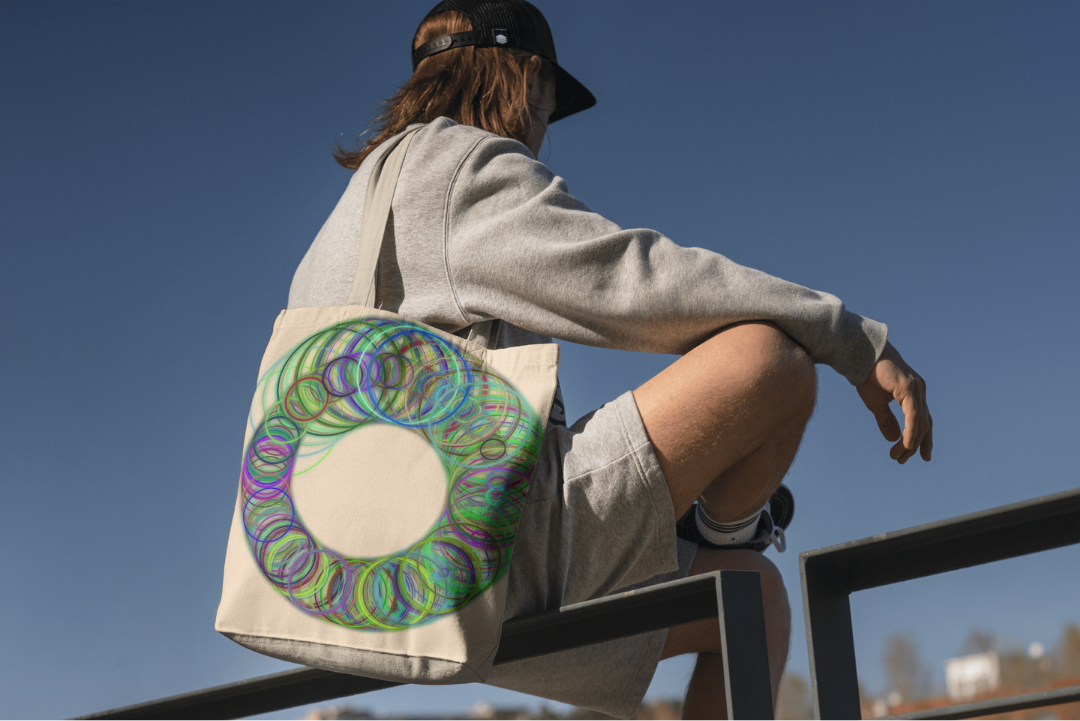
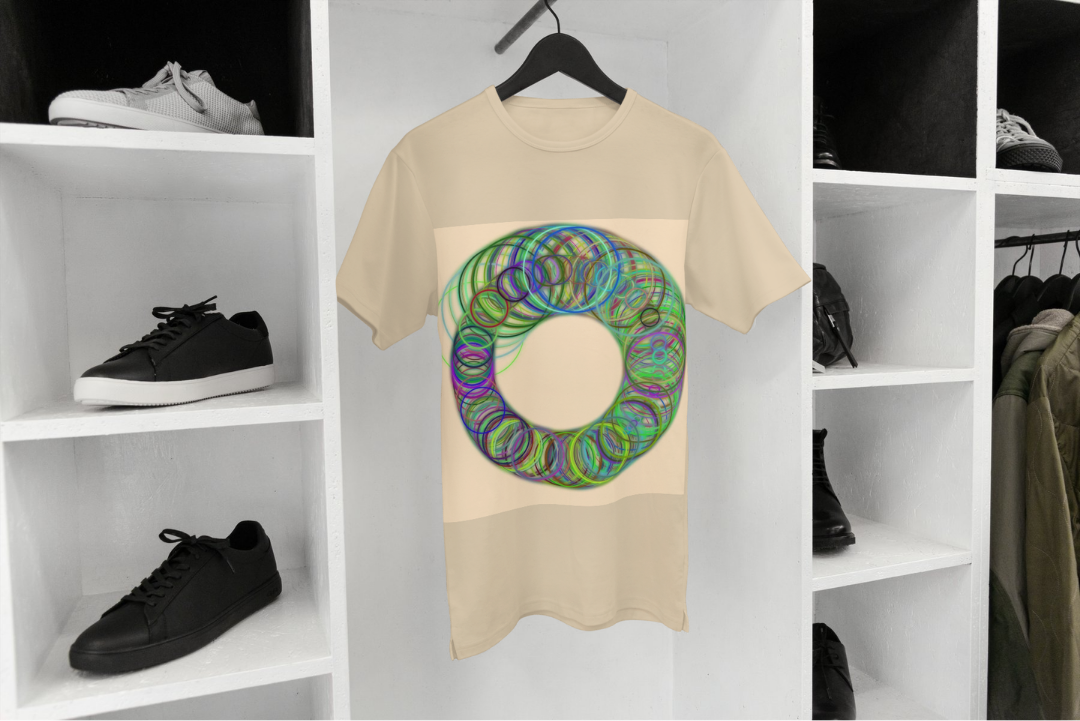
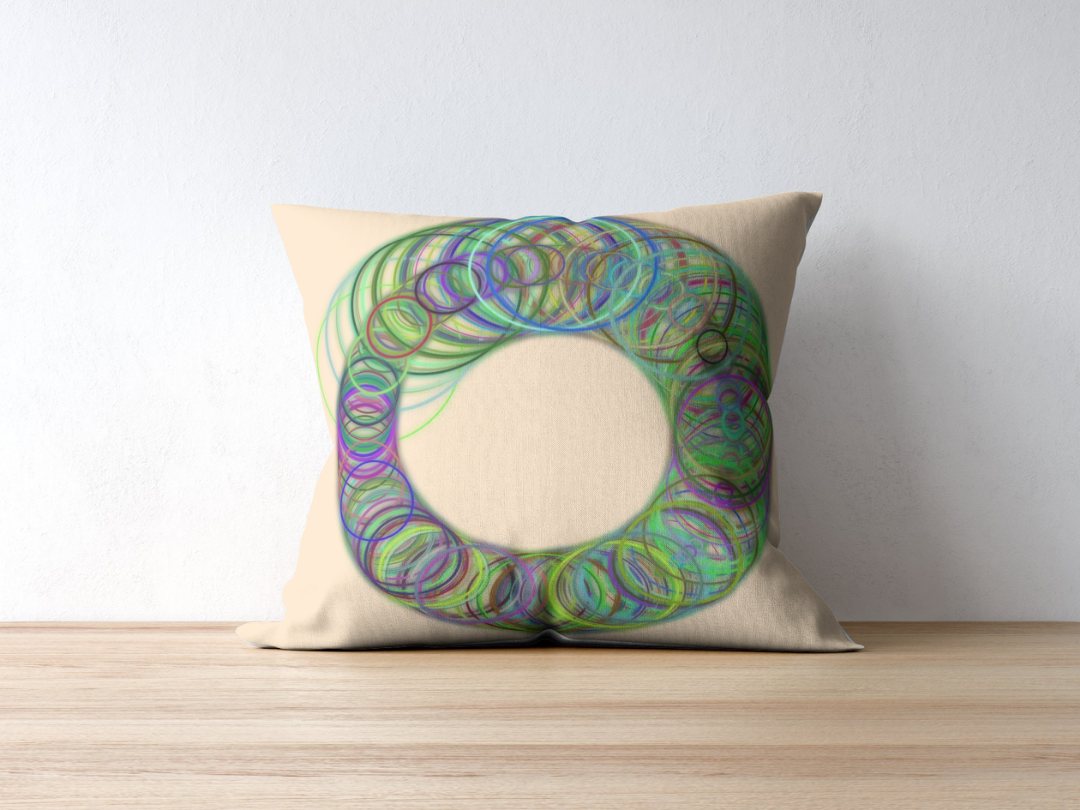
Each surface is drawn from the same numeric seed — reproducible, licensable, adaptable to your brief.