Six by Six
A 6 × 6 grid divides the canvas into 36 cells. Each cell holds one organic form, centred in its cell. Every form has its own size (0.5–0.9 of the cell), its own rotation (0–2π), and its own colour drawn from the palette.
A 6 × 6 grid of layered organic forms, each drawn from a flowing parametric formula and rendered in three concentric strokes. Five curated palettes — Ice, Fire, Strawberry, Forest, Sunset.
For fashion houses, textile studios and surface designers. Each composition is generated from a numeric seed and can be licensed, adapted or commissioned to your brief.
A parametric curve, repeated with variation, becomes a field of blossoms.
I am an Iranian-born artist working at the intersection of botanical form and generative systems. My work begins with a simple observation: the layered petal — repetitive, mathematically structured, infinitely variable — has always been a form of computation, long before computers.
Organic Shapes renders a 6 × 6 grid of layered organic forms. Each form is drawn from a flowing parametric formula: a base radius modulated by two sine and cosine waves at different frequencies, sampled at 120 points around the circle. Every form is rendered in three concentric strokes at descending brightness, so the outline reads as a soft layered contour rather than a single hard line.
Five palettes are available — Ice, Fire, Strawberry, Forest, and Sunset — each with four colours drawn from a different natural register. The background is a deep blue-violet at low saturation. The result sits between botanical illustration and Op-art. Each piece is defined by a numeric seed and can be regenerated, documented, and adapted for print, textile, and surface applications.
The same seed, presented as an archival print — and applied across fabric, scarf, textile and wall surfaces without loss of structure.
Every surface below is drawn from the same numeric seed — its repeat, orientation and scale adapted to the material, while the underlying structural logic remains identical.
A 6 × 6 grid divides the canvas into 36 cells. Each cell holds one organic form, centred in its cell. Every form has its own size (0.5–0.9 of the cell), its own rotation (0–2π), and its own colour drawn from the palette.
Each form is drawn from a parametric equation: a base
radius modulated by sin(3θ) and
cos(5θ), sampled at 120 points around the
circle. This produces a soft, petal-like contour with
three lobes and five gentle notches — organic, never
a perfect circle.
Every form is drawn three times: once at full brightness, once at −10 brightness with −15% alpha, and once at −20 brightness with −30% alpha. The result is a layered contour that reads as three nested outlines — an echo of the form inside itself.
Organic Shapes is a generative design system rather than a single artwork. Its petal-form language can be adapted for fashion, textile development and other surface-oriented contexts — while maintaining a computational origin.

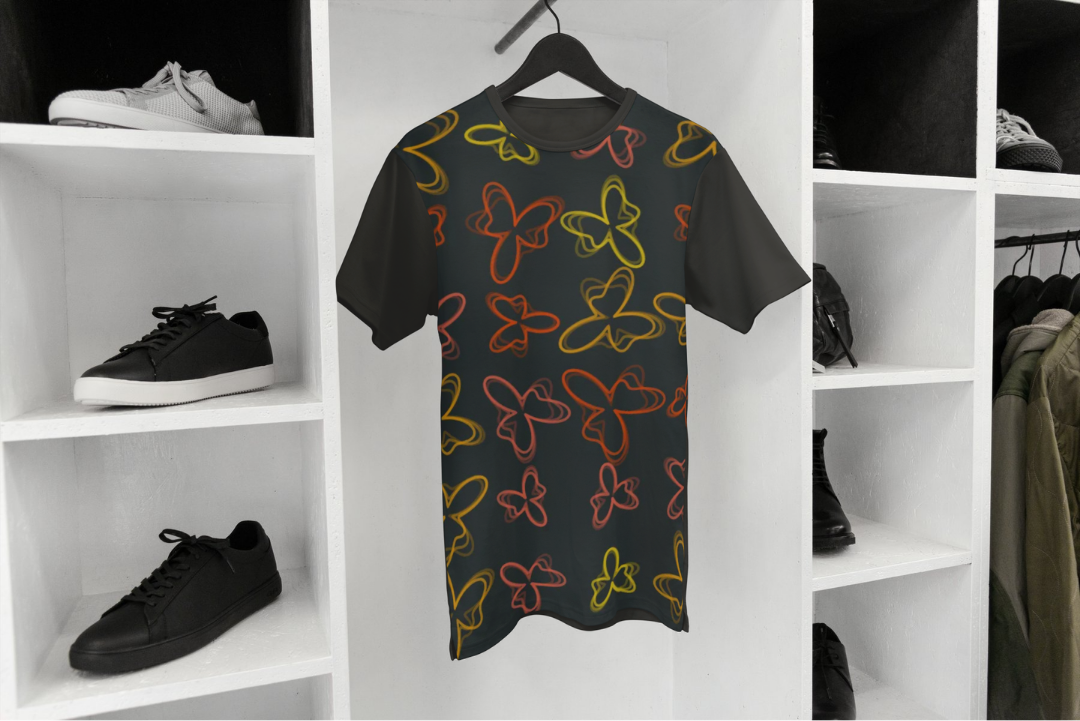
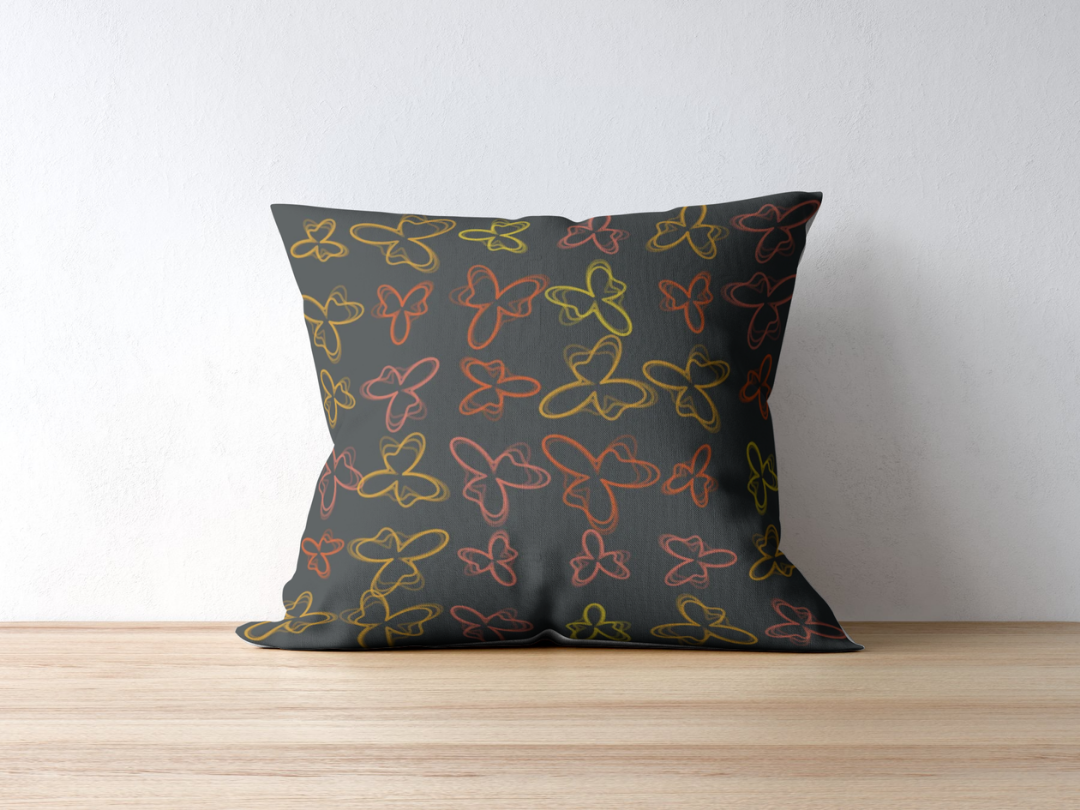
Each surface is drawn from the same numeric seed — reproducible, licensable, adaptable to your brief.