Order to Chaos — Catalogue 80 × 80 Cells · Gradient Blend · Seed-Based
A study in gradual disorder

Order to Chaos

An 80 × 80 grid that drifts from regular order on the left to noise-driven disorder on the right. Rectangles, ellipses, triangles in harmonic palettes.

For fashion houses, textile studios and surface designers. Each composition is generated from a numeric seed and can be licensed, adapted or commissioned to your brief.

Issue Order to Chaos — Autumn 2026
Discipline Generative Grid Composition
Edition Seed-based · Open series
00 / Statement Artist Statement

A grid drawn along a gradient becomes a field that forgets its own rules.

I am an Iranian-born artist working at the intersection of mosaic logic and generative systems. My work begins with a simple observation: the tiled surface — repetitive, mathematically structured, infinitely variable — has always been a form of computation, long before computers.

Order to Chaos renders an 80 × 80 grid whose cells drift along a horizontal gradient. On the left, cells are lit or dark according to a strict sine/cosine lattice modulated by a radial field — regular, rhythmic, almost architectural. On the right, cells follow 2D Perlin noise plus a random chaos term — scattered, irregular, almost organic. Between the two, the blend factor slides smoothly from order to disorder.

Every lit cell draws itself as a rectangle, an ellipse, or a triangle, in a small harmonic palette generated per seed: complementary, analogous, or triadic. A dim background wash and a scattered glow effect complete the composition. Each piece is defined by a numeric seed and can be regenerated, documented, and adapted for print, textile, and surface applications.

On AI tools — where I encountered technical obstacles, I turned to AI tools for debugging and code optimization. Every structural, aesthetic, and conceptual decision remained my own.
01 / Plate

One gradient,
infinite seeds.

02 / Surfaces

One gradient.
Many surfaces.

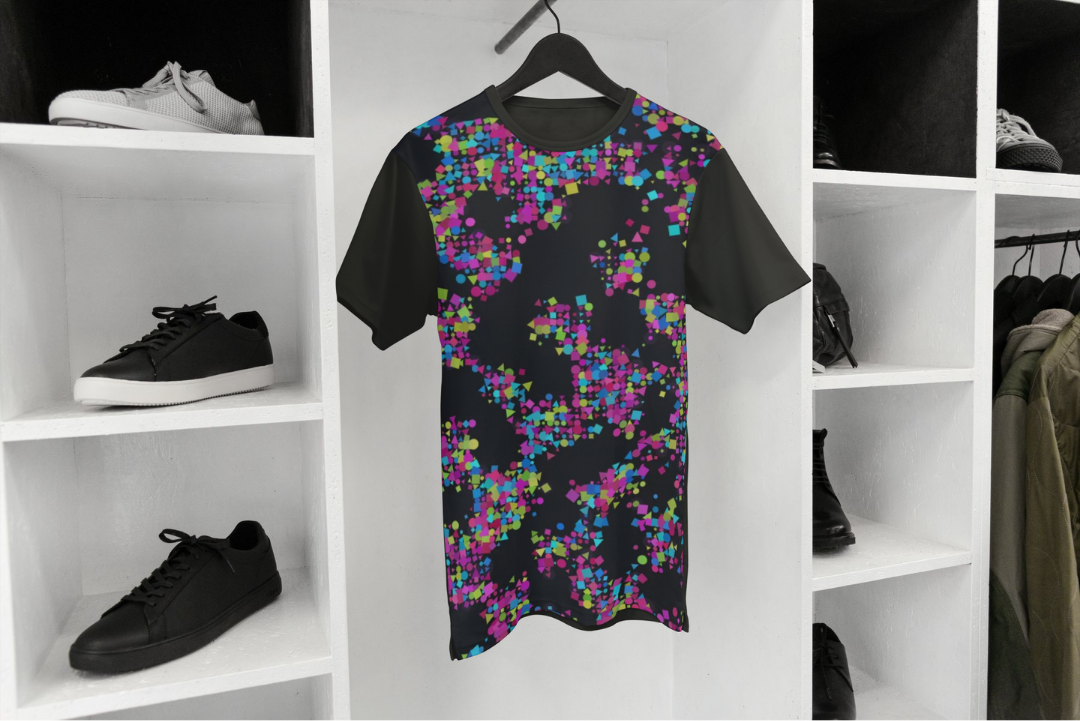
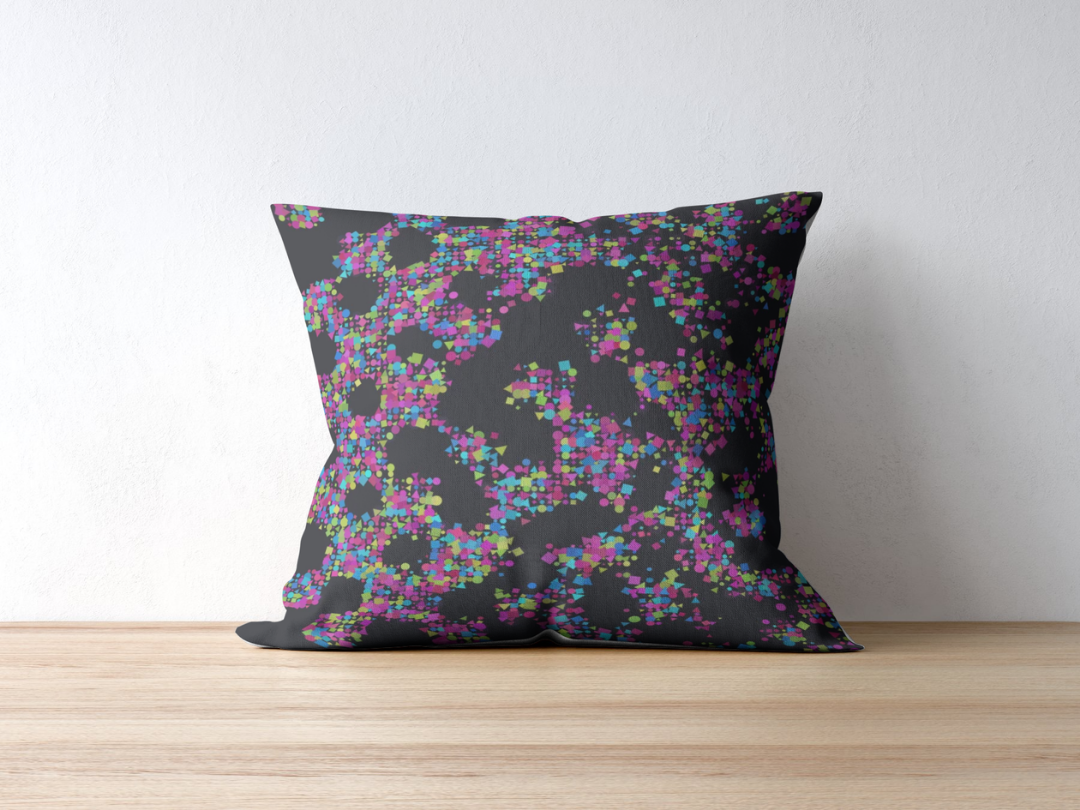
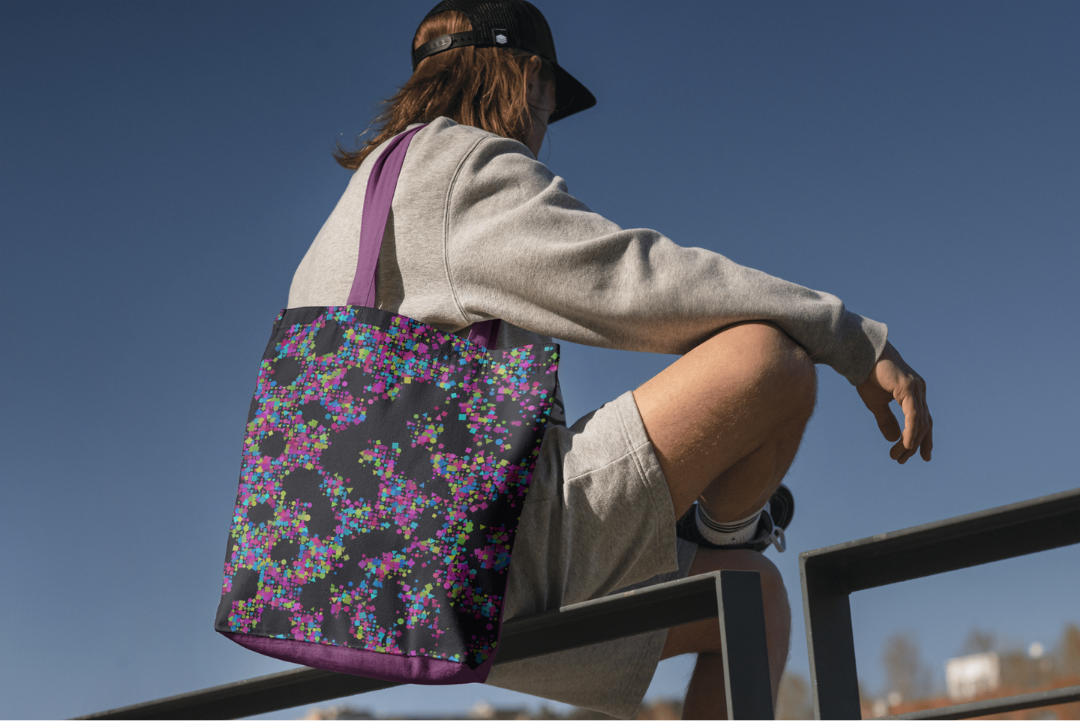
The same seed, presented as an archival print — and applied across fabric, scarf, textile and wall surfaces without loss of structure.

Plate 008 Archival print · 1 : 1 · Open edition

Applied across surfaces.

Every surface below is drawn from the same numeric seed — its repeat, orientation and scale adapted to the material, while the underlying structural logic remains identical.

iPrint
Archival print
1 : 1 · Cotton rag
iiScarf
Silk scarf
3 : 1 · Twill silk
iiiTextile
Fabric yardage
4 : 3 · Repeat tile
ivWall
Wallpaper
2 : 3 · Vertical repeat
03 / Process

Structure
behind the gradient.

01 / Order

Lattice & Rings

On the left edge, cells follow a strict lattice: a product of two sines and cosines at 10× frequency, plus a radial field modulated by a two-period sine. The result is regular, rhythmic, almost architectural — a woven surface in the classical sense.

02 / Chaos

Noise & Random

On the right edge, cells follow 2D Perlin noise at 5× frequency, plus a flat random chaos term of up to 0.6. The result is scattered, irregular, almost organic — no two rows alike. Between the two edges, a horizontal blend factor `t = i / (cols − 1)` slides smoothly from order to disorder.

03 / Shapes

Three Forms

Each lit cell draws itself as one of three shapes — rectangle, ellipse, or triangle — at a random size (0.4–1.6× cell), a random rotation (up to 90°), and a colour drawn from a small harmonic palette. Complementary, analogous, or triadic harmony is chosen per seed.

04 / Archive

Selected
seeds.

8 compositions · Open series Click any plate to load it above
For brands & studios

One system.
Many surfaces.

Order to Chaos is a generative design system rather than a single artwork. Its gradient language can be adapted for fashion, textile development and other surface-oriented contexts — while maintaining a computational origin.

i
Licensing Existing seeds from the archive, licensed for production use.
ii
Commission New compositions designed to your palette, repeat and product.
iii
Systems A private generative tool built for your studio's ongoing use.
Begin a Conversation