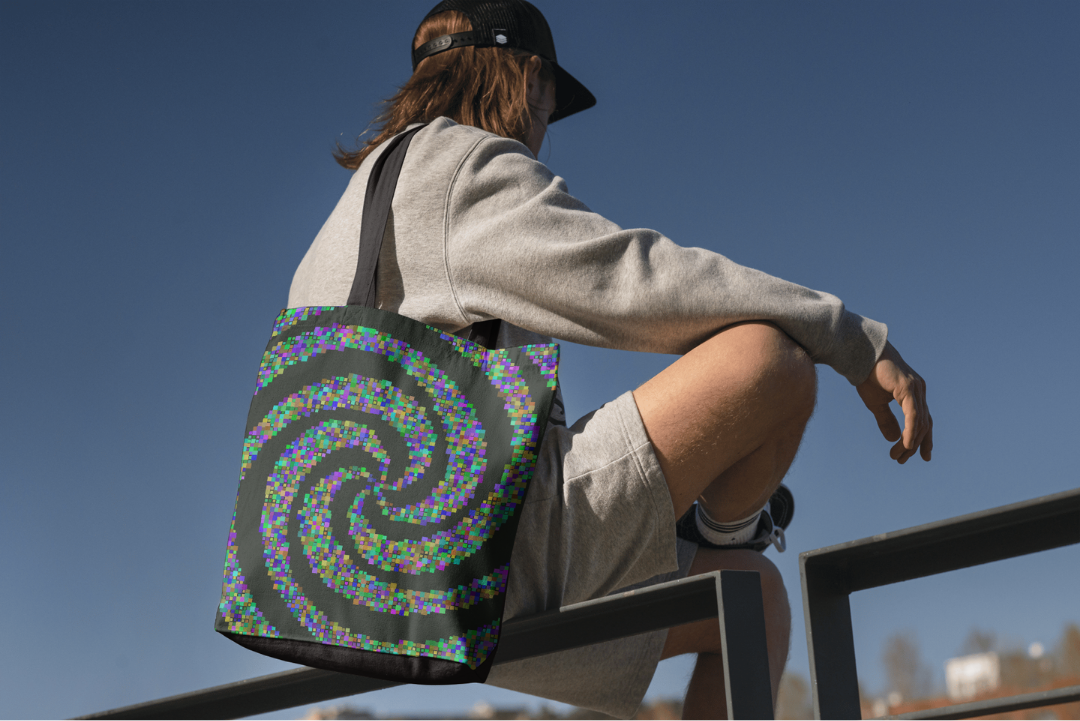
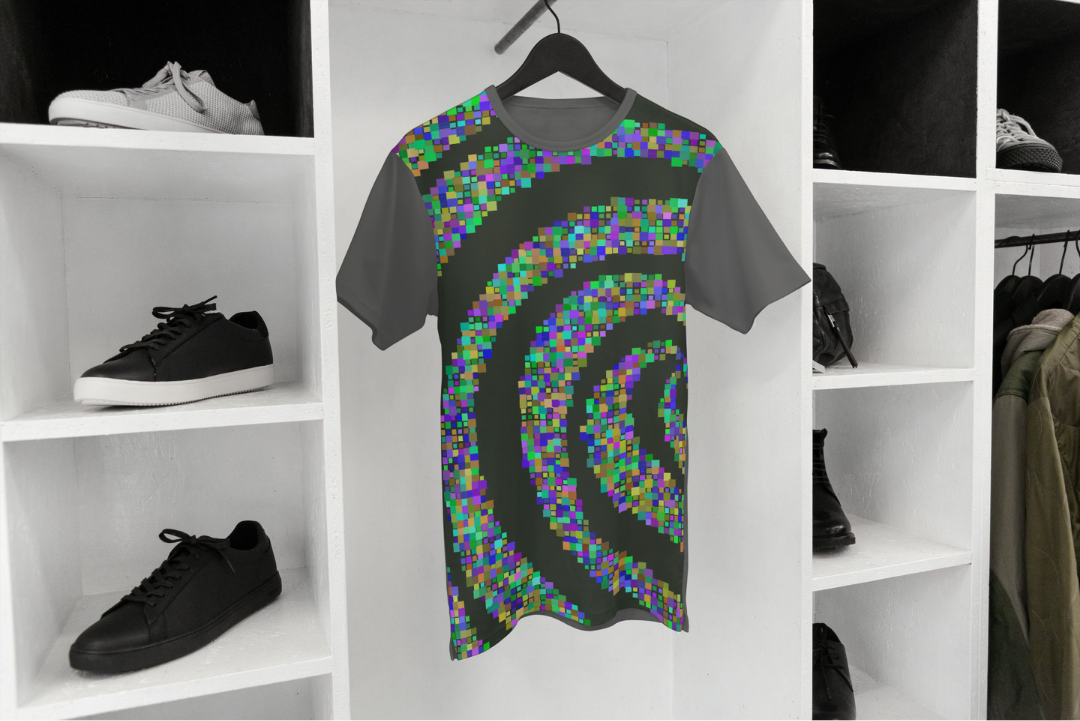
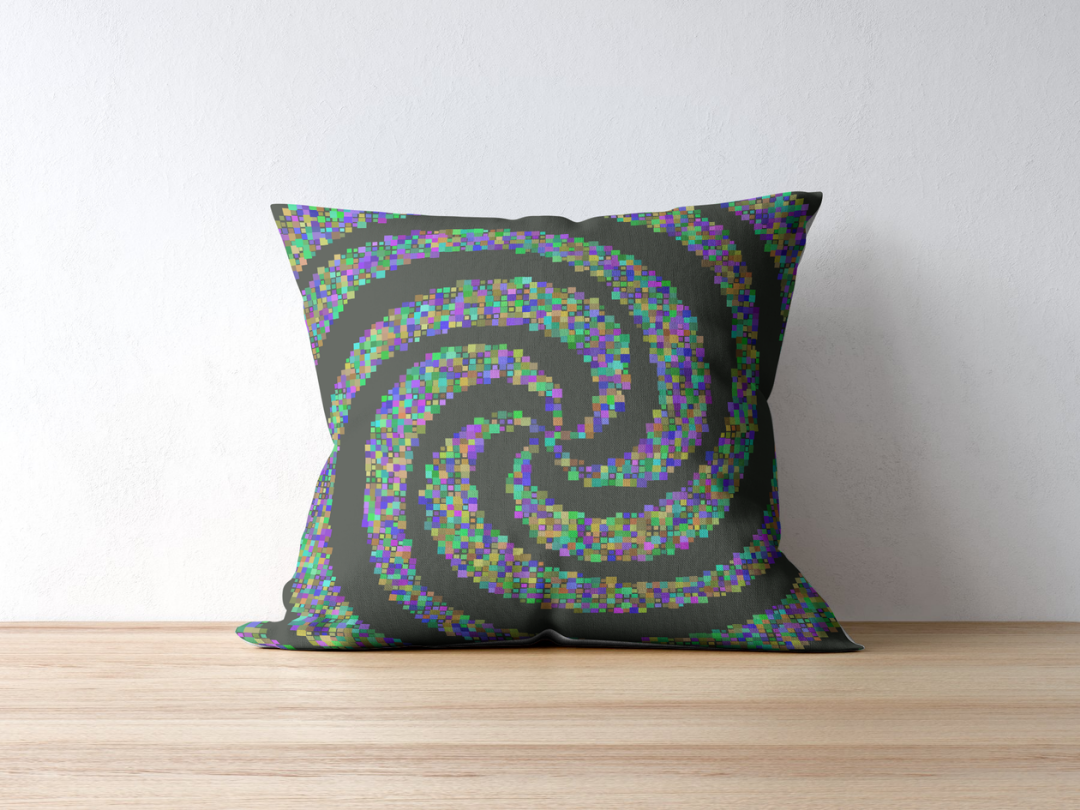
A wave crosses a grid, crosses a threshold,
and becomes a field of tiles.
I am an Iranian-born artist working at the intersection of
classical textile logic and generative systems. My work
begins with a simple observation: the woven surface —
repetitive, mathematically structured, infinitely variable —
has always been a form of computation, long before computers.
Mosaic Field lays an 80 × 80 grid across
the canvas and fills it with a mathematical field — circular
waves, checkerboards with noise, organic blobs, concentric
rings, random dots, or swirls. Each value is compared to a
threshold curve that itself varies with distance from the
centre, and the cell is set on or off accordingly. What
survives the threshold becomes a tile: a square, a circle,
or a rotated square, chosen once per composition.
Colour is generated as a coherent set rather than picked
from a palette — a base hue is drawn opposite the background,
and two to five hues are spaced around it with jitter. A
final pass adds one of three luminous effects: glow dots,
connecting lines, or cross patterns. Each piece is defined
by a numeric seed and can be regenerated, documented, and
adapted for textile, print, and surface applications.
On AI tools — where I encountered technical
obstacles, I turned to AI tools for debugging and code
optimization. Every structural, aesthetic, and conceptual
decision remained my own.