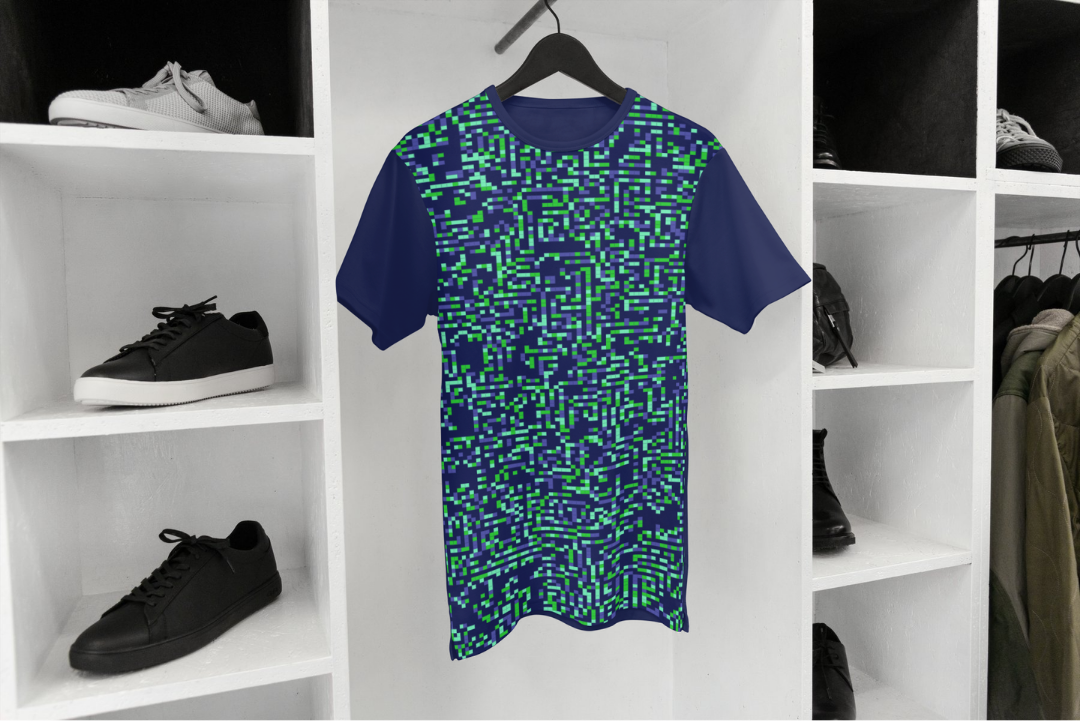
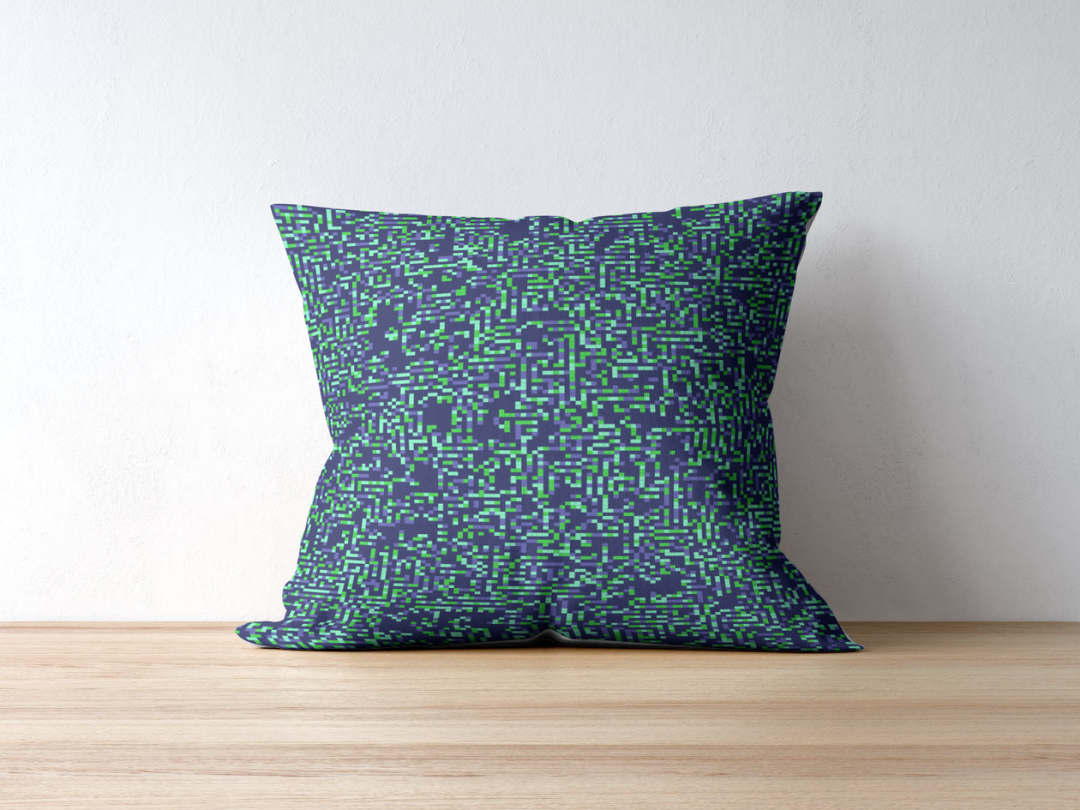
Every cell is a small decision — and every decision
rewrites the one after it.
I am an Iranian-born artist working at the intersection of
classical textile logic and generative systems. My work
begins with a simple observation: the woven surface —
repetitive, mathematically structured, infinitely variable —
has always been a form of computation, long before computers.
Maze of Life draws from the traditions of
cellular automata — grids of cells that evolve according
to simple neighbourhood rules. Each seed initializes a
grid (100–200 columns × 100–200 rows), applies the rules
for 500 to 10,500 generations, and stabilizes into a maze
of colour and void.
What remains is a texture — the trace of rules that
interacted and settled. Each cell is coloured from a
shared foreground palette; each generation rewrites
the grid. The final composition is emergent:
neither planned nor random, but the inevitable result
of a small rule applied thousands of times.
On AI tools — where I encountered technical
obstacles, I turned to AI tools for debugging and code
optimization. Every structural, aesthetic, and conceptual
decision remained my own.