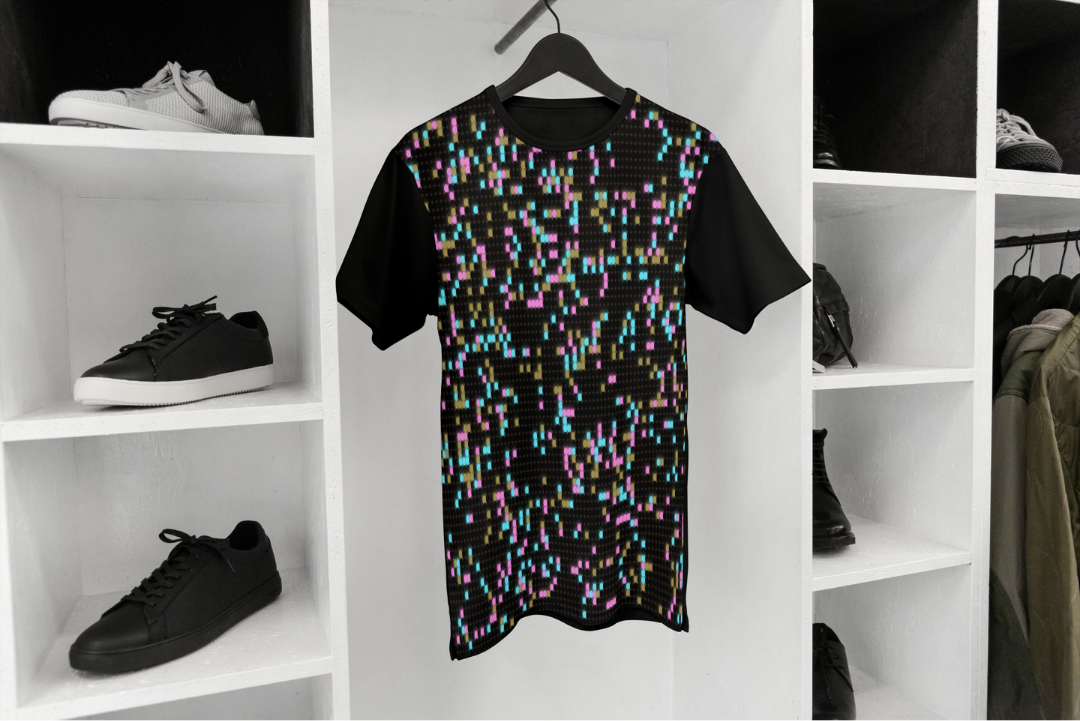
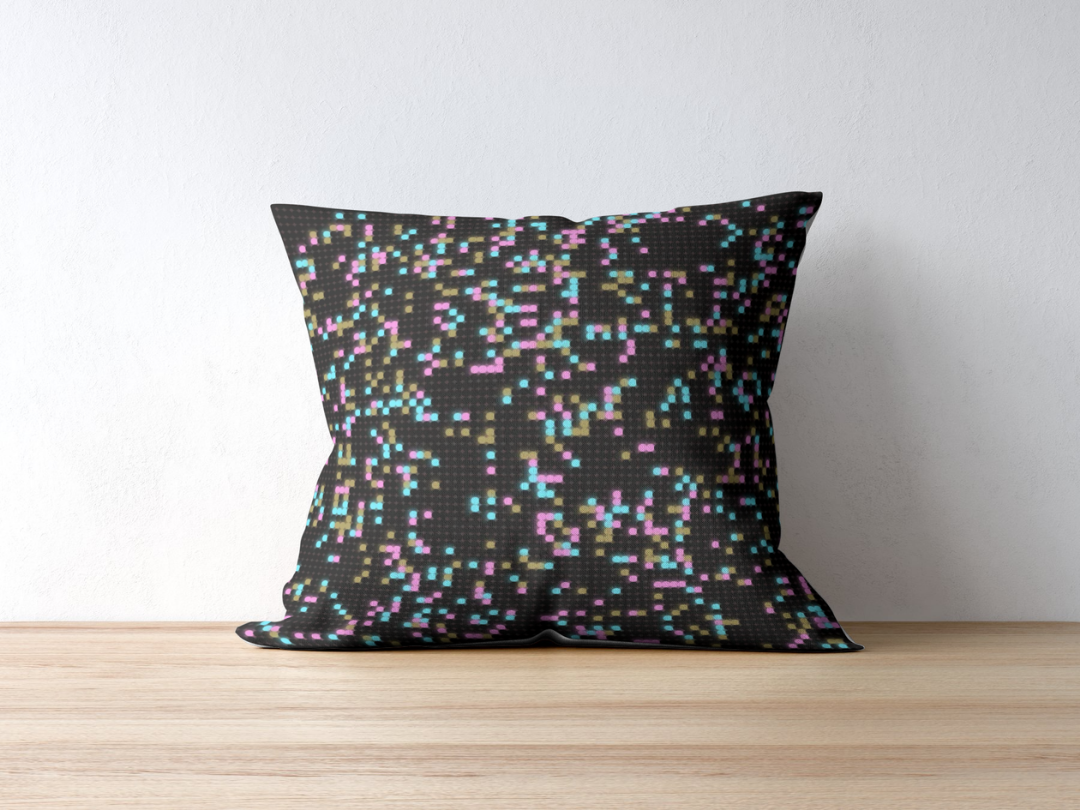
A rule, iterated without end,
becomes a field with its own life.
I am an Iranian-born artist working at the intersection of
cellular automata and generative systems. My work begins
with a simple observation: the local rule — repeated over
and over on a grid — has always been a form of computation,
long before computers.
Game of Seeds renders a cellular automaton
in the tradition of Conway's Game of Life, but with a
custom rule: a dead cell comes alive if exactly two of its
eight neighbours are alive, and a live cell dies otherwise.
The grid is seeded with 10–30 three-cell groups placed at
random positions and orientations, then iterated between
30 and 2030 times.
Every live cell is drawn as a coloured dot with a soft
glow, at a scale proportional to the cell size. Every dead
cell is drawn as a black dot, so the pattern reads as an
ornamental mosaic against the coloured ground. The result
sits between biological simulation and geometric ornament.
Each piece is defined by a numeric seed and can be
regenerated, documented, and adapted for print, textile,
and surface applications.
On AI tools — where I encountered technical
obstacles, I turned to AI tools for debugging and code
optimization. Every structural, aesthetic, and conceptual
decision remained my own.