Variation
A numeric seed picks three ellipse colours, a saturated background, a starting rotation, and the exact offset applied to each ring. Each output is regenerated and documented as a distinct, traceable work.
Concentric rings sized by the Fibonacci series, rotated one step at a time, scattered across a saturated ground.
For fashion houses, textile studios and surface designers. Each composition is generated from a numeric seed and can be licensed, adapted or commissioned to your brief.
Each ring is the sum of the last two — and every ring is larger than both.
I am an Iranian-born artist working at the intersection of classical textile logic and generative systems. My work begins with a simple observation: the woven surface — repetitive, mathematically structured, infinitely variable — has always been a form of computation, long before computers.
Fibonacci Circles takes the series as its organising principle. Ellipses are sized by the Fibonacci numbers, stacked concentrically at incrementing rotations, so that each ring is a little further turned than the one before it. Three seeded colours thread through the sequence; a saturated ground holds it all in place.
Thirty scattered lines cross the composition at random, cutting the symmetry with raw gesture. Together they read as an exploded diagram — half instrument, half drawing. Each piece is defined by a numeric seed and can be regenerated, documented, and adapted for textile, print, and surface applications.
The same seed, presented as an archival print — and applied across fabric, scarf, textile and wall surfaces without loss of structure.
Every surface below is drawn from the same numeric seed — its repeat, orientation and scale adapted to the material, while the underlying structural logic remains identical.
A numeric seed picks three ellipse colours, a saturated background, a starting rotation, and the exact offset applied to each ring. Each output is regenerated and documented as a distinct, traceable work.
Fibonacci numbers are generated up to 1000. Each is scaled to canvas size and drawn as an ellipse, rotated by a small increment at every step. Thirty random lines cross the composition at the end, cutting through the symmetry.
The resulting composition becomes a surface-design asset — explored across garments, textile prints, wallpaper and other pattern-driven applications.
Fibonacci Circles is a generative design system rather than a single artwork. Its series-driven language can be adapted for fashion, textile development and other surface-oriented contexts — while maintaining a computational origin.
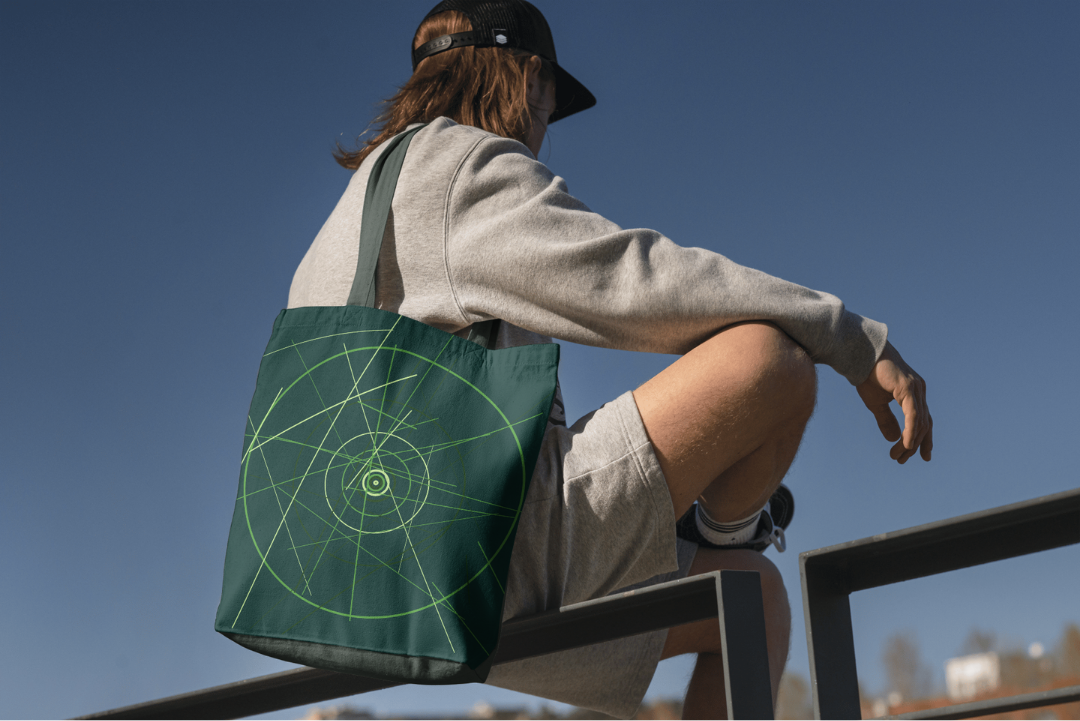
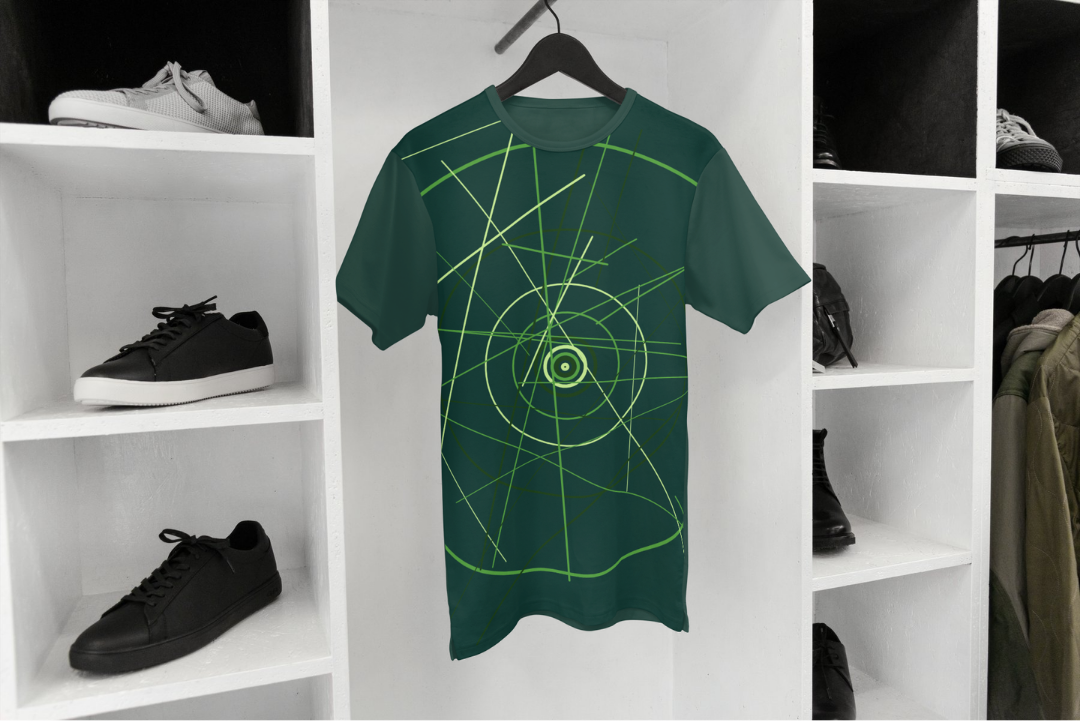
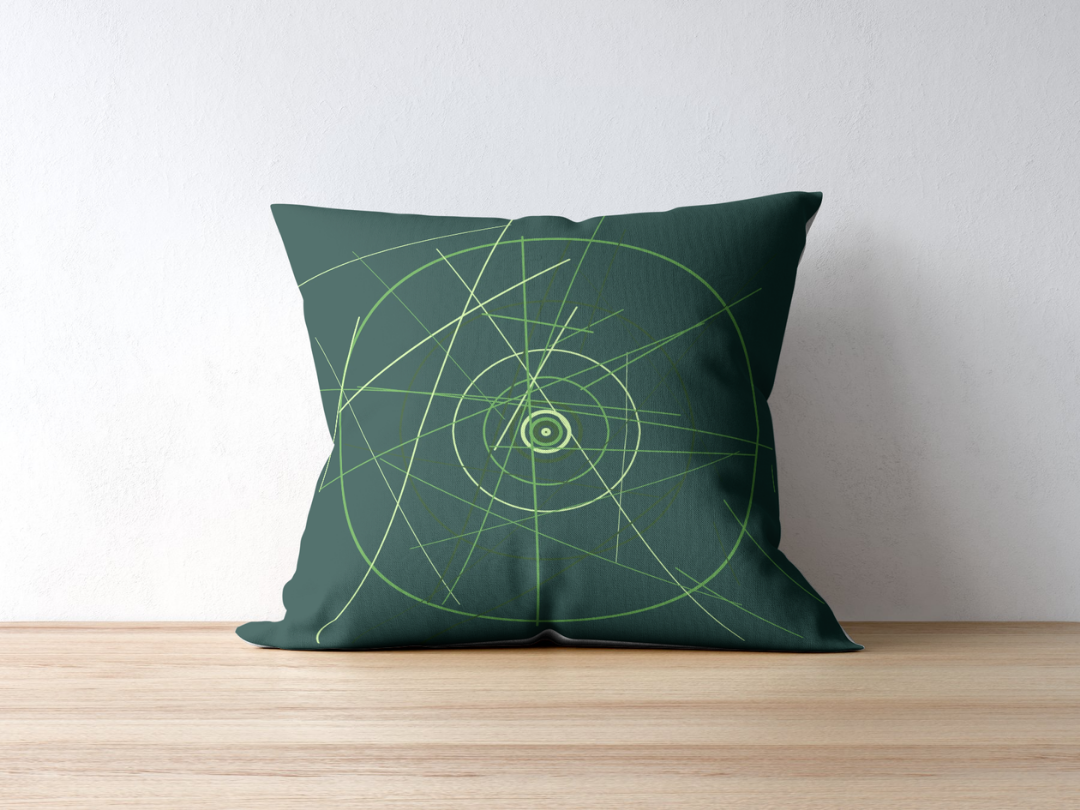
Each surface is drawn from the same numeric seed — reproducible, licensable, adaptable to your brief.