Two Sides
A yellow range (hue 50–70) meets a black range (hue 220–260), each with its own saturation and brightness bands. Battle intensity — drawn from the seed — decides the grid density, the noise amplitude, and the winning side.
Two colour-forces — yellow and black — resolved across grid, wave and ring.
For fashion houses, textile studios and surface designers. Each composition is generated from a numeric seed and can be licensed, adapted or commissioned to your brief.
Two colours meet on a grid, and the grid decides who wins.
I am an Iranian-born artist working at the intersection of classical textile logic and generative systems. My work begins with a simple observation: the woven surface — repetitive, mathematically structured, infinitely variable — has always been a form of computation, long before computers.
Battle Field stages a conflict between two colour-forces: a bright yellow range and a deep blue-black range. Each seed selects a battlefield — a checkerboard, a wavefront, or concentric rings — and lets the two sides resolve across it. Battle intensity governs grid density, wave amplitude, and the ratio of yellow to black.
The result is a poster-like field of pure HSB colour blocks, half diagram, half skirmish. Each piece is defined by a numeric seed and can be regenerated, documented, and adapted for textile, print, and surface applications.
The same seed, presented as an archival print — and applied across fabric, scarf, textile and wall surfaces without loss of structure.
Every surface below is drawn from the same numeric seed — its repeat, orientation and scale adapted to the material, while the underlying structural logic remains identical.
A yellow range (hue 50–70) meets a black range (hue 220–260), each with its own saturation and brightness bands. Battle intensity — drawn from the seed — decides the grid density, the noise amplitude, and the winning side.
One of three formations is chosen: a checkerboard with per-cell noise flips, a sine-wave front with distance-based colour mixing, or concentric rings with damage-jittered thickness. Each resolves the same two forces on different geometry.
The resulting composition becomes a surface-design asset — explored across garments, textile prints, wallpaper and other pattern-driven applications.
Battle Field is a generative design system rather than a single artwork. Its two-force colour language can be adapted for fashion, textile development and other surface-oriented contexts — while maintaining a computational origin.
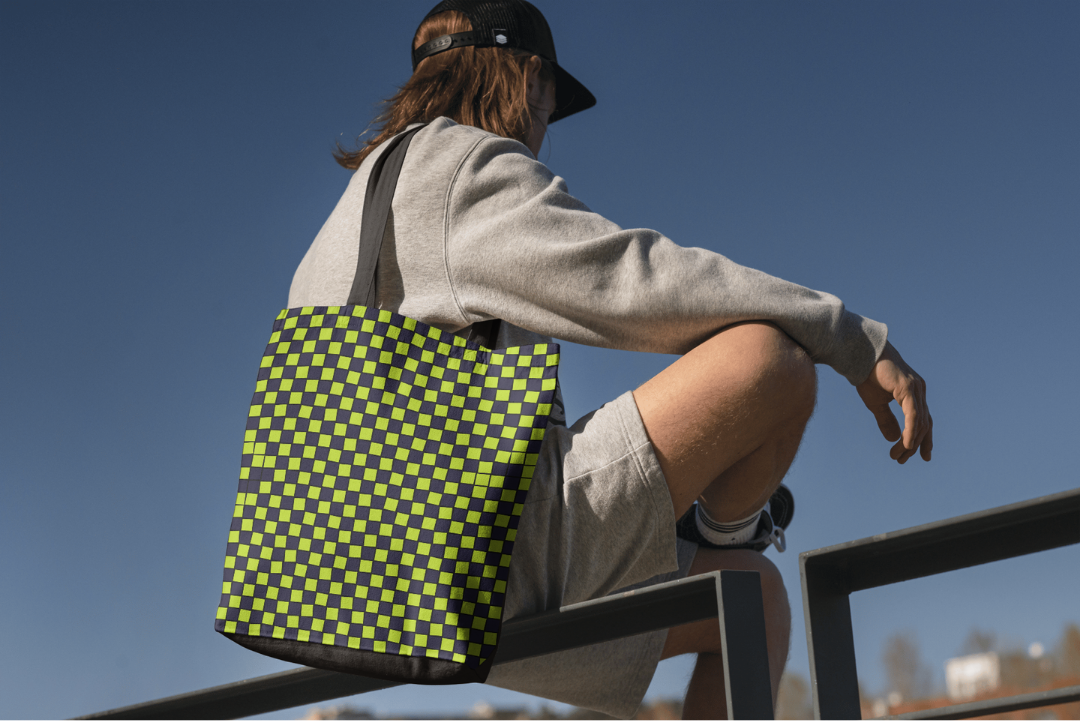
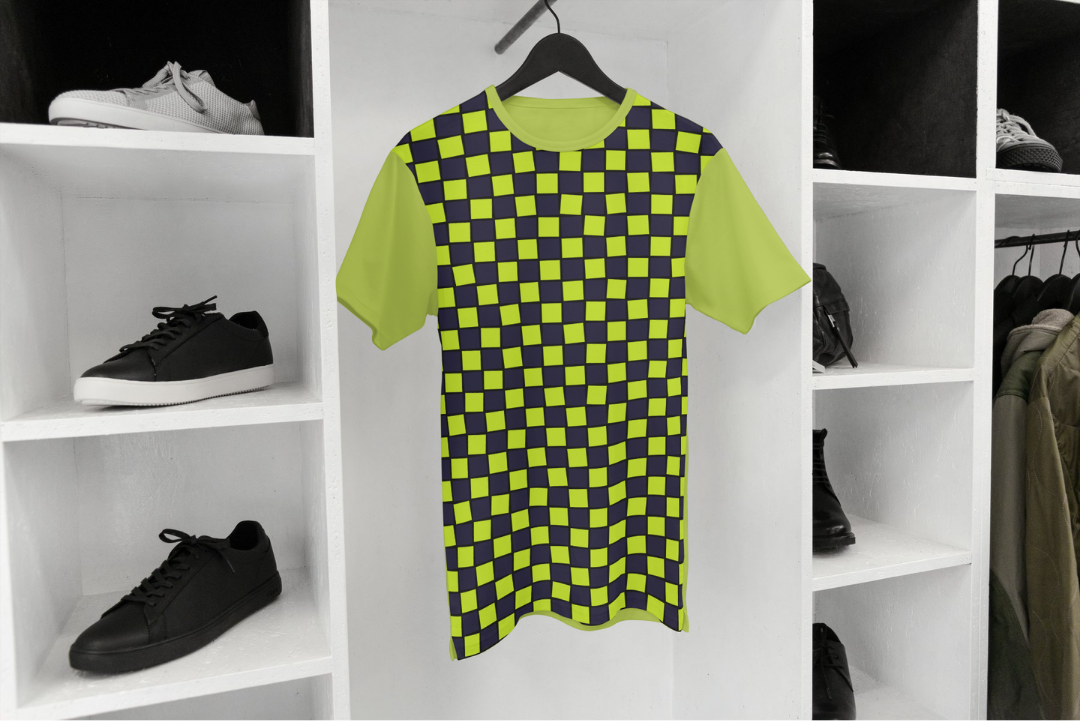
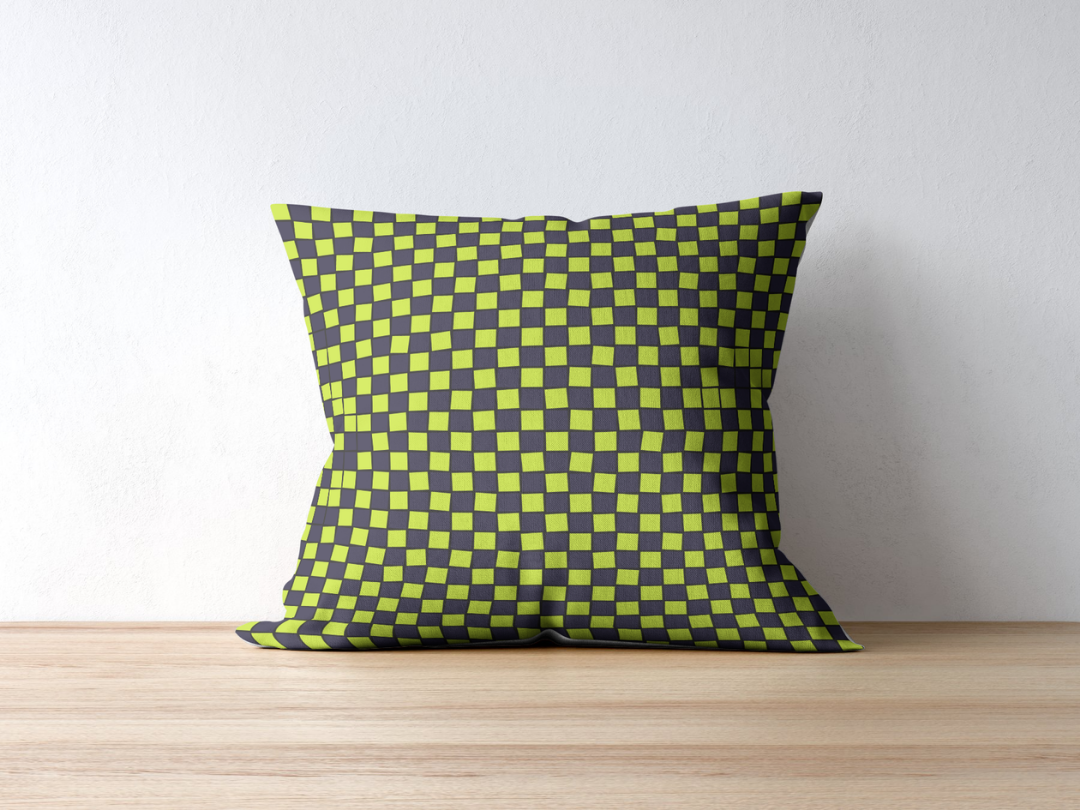
Each surface is drawn from the same numeric seed — reproducible, licensable, adaptable to your brief.